How to Build Your Own Workout Routine (Step by Step)
You do not need a template someone else wrote. Here is the full process for building a workout plan that fits your schedule, your goal and your recovery.
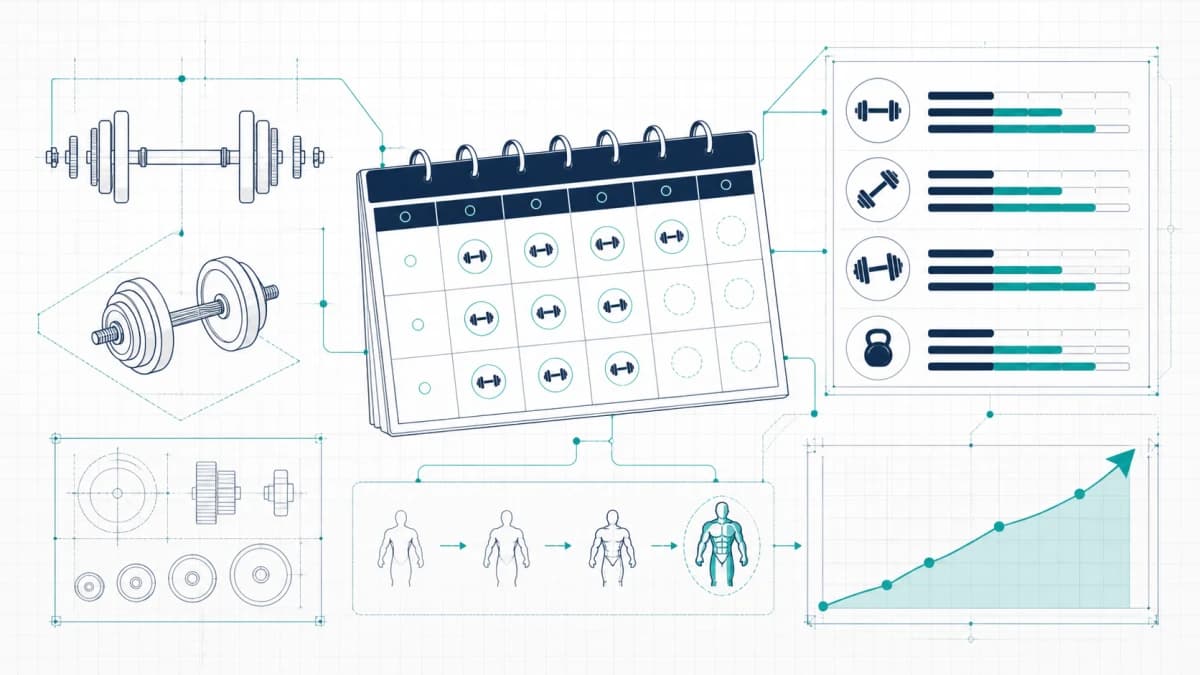
Most people do not fail in the gym because they picked the wrong exercises. They fail because they never had a plan, or the plan was built for someone else's schedule and recovery. Building your own program is not complicated. It comes down to seven decisions, made once, then repeated for weeks.
This guide walks you through each decision in order: frequency, split, exercise selection, sets and reps, progression, deloads and nutrition. By the end you will have a complete plan you wrote yourself and actually understand.
Step 1: choose how many days you can really train
Start with your calendar, not your ambition. A 3-day plan you complete every week beats a 6-day plan you abandon in March. Be honest about work, family and how you recover, then commit to a number.
- 3 days a week: enough for real strength and muscle gains, ideal for beginners and busy people.
- 4 days a week: the sweet spot for most intermediates, more volume without living in the gym.
- 5 days a week: shorter sessions with more focus per muscle, best if training is already a habit.
Step 2: pick a split that matches your frequency
A split is just how you divide your muscles across the week. The right one follows directly from step 1, because every muscle should be trained at least twice a week for best results. That single rule eliminates most bad splits, including the classic one-muscle-per-day bro split.
- 3 days: full body. Every session trains the whole body with 4 to 6 exercises. Each muscle gets hit three times a week.
- 4 days: upper/lower. Two upper body days, two lower body days, for example Monday, Tuesday, Thursday, Friday.
- 5 days: upper/lower plus a full body day, or push/pull/legs with upper and lower repeated. Push/pull/legs run once through only trains each muscle once a week, so at 5 days you cycle it continuously rather than fixing days to muscles.
If you are unsure, take the upper/lower split. It scales from 2 to 6 days, keeps sessions under an hour and makes it easy to balance pushing and pulling.
Step 3: select exercises by movement pattern, not by muscle
Do not build sessions from a random list of favorites. Cover the six basic movement patterns each week and every major muscle gets trained automatically: squat, hinge, horizontal push, horizontal pull, vertical push and vertical pull.
- Squat pattern: back squat, goblet squat, leg press, split squat.
- Hinge pattern: deadlift, Romanian deadlift, hip thrust, kettlebell swing.
- Horizontal push: bench press, dumbbell press, push-up.
- Horizontal pull: barbell row, cable row, chest-supported row.
- Vertical push: overhead press, landmine press.
- Vertical pull: pull-up, lat pulldown.
Structure each session the same way: one or two big compound lifts first while you are fresh, then two to four smaller accessory movements such as curls, lateral raises, leg curls or core work. Beginners should keep the same exercises for at least 8 to 12 weeks. You cannot measure progress on a lift you keep swapping out.
Step 4: set your reps and sets by goal
Rep ranges are not magic, but they do bias the adaptation. Heavier loads and lower reps drive strength. Moderate loads with more reps are the most practical way to accumulate muscle-building volume. High reps build work capacity and endurance.
- Strength: 3 to 6 reps per set, 3 to 5 sets, long rests of 2 to 4 minutes. Mostly big barbell lifts.
- Muscle growth: 6 to 12 reps per set, 3 to 4 sets, rests of 1.5 to 3 minutes.
- Endurance and conditioning: 12 to 20 reps, 2 to 3 sets, short rests under 90 seconds.
Total weekly volume matters more than any single session. Aim for roughly 10 to 20 hard sets per muscle group per week, counted across all sessions. Beginners grow well at the bottom of that range. Take most sets to about 1 to 3 reps short of failure; grinding every set to a complete stop just buries your recovery.
Step 5: plan progression before you need it
A workout plan without a progression rule is just a list of exercises. The simplest system that works is double progression. Pick a rep bracket for each lift, say 8 to 12. Keep the weight fixed and add reps week to week. When you hit the top of the bracket on every set, add 2.5 kg (or the smallest jump your gym allows) and drop back to 8 reps.
Write everything down: exercise, weight, reps, and how hard it felt. Whether that is a notebook or an app does not matter. What matters is that next week you know exactly what you have to beat. Progress will not be linear forever, and that is fine. Beating your logbook by one rep anywhere in the session still counts.
Step 6: schedule deloads before burnout schedules them for you
After 6 to 8 weeks of pushing weights up, fatigue accumulates faster than you notice. Joints ache, sleep gets worse, and lifts that felt crisp start feeling heavy at warm-up weights. That is the signal to deload, not to push harder.
Also deload proactively before or after events you cannot control: a heavy work stretch, travel, illness. Coming back at 90% beats limping along at 60% for three weeks.
Step 7: plug in your nutrition targets
Training is the stimulus. Food decides what your body does with it. The same plan can make you leaner or bigger depending on your calories, so set a target before week one. Start from your Total Daily Energy Expenditure, the calories you burn in a full day.
Then split those calories into macros. Protein is the priority for anyone lifting: 1.6 to 2.2 g per kilogram of body weight per day is the range most sports nutrition research supports. Fill the rest with enough carbs to fuel training and enough fat for health, roughly 20 to 35% of calories.
Putting it all together: a sample 4-day plan
Here is what the seven steps produce for someone training four days a week with muscle gain as the goal. Sessions run 45 to 60 minutes.
- Monday, upper: bench press 4x6-8, barbell row 4x6-8, overhead press 3x8-10, lat pulldown 3x10-12, curls and lateral raises 2x12-15 each.
- Tuesday, lower: back squat 4x6-8, Romanian deadlift 3x8-10, leg press 3x10-12, leg curl 3x12-15, calf raises 3x12-15, plank 3 sets.
- Thursday, upper: overhead press 4x6-8, pull-up 4 sets near failure, incline dumbbell press 3x8-12, cable row 3x10-12, triceps and rear delts 2x12-15 each.
- Friday, lower: deadlift 3x4-6, split squat 3x8-10 per leg, hip thrust 3x10-12, leg extension 3x12-15, hanging knee raises 3 sets.
Run it with double progression, deload on week 7, eat to your calculated targets, and review the whole plan after 12 weeks. That is the entire job. Nothing here requires a coach, just consistency and honest logging.
Frequently asked questions
Further reading on Trainera
- How to Build a Workout Routine
- Online coaching platform for personal trainersRun your online coaching in one systemin your clients' own language.
In-depth guides from Trainera, the coaching app that sponsors this site.