Is 1,200 Calories a Day Too Low?
The 1,200-calorie floor is an old default, not a personalized target. For most adults it undershoots real needs and backfires. Here's how to set a smarter deficit.
Calculate it for yourself
Calorie Deficit Calculator
Daily calories to reach a goal weight by a set date.
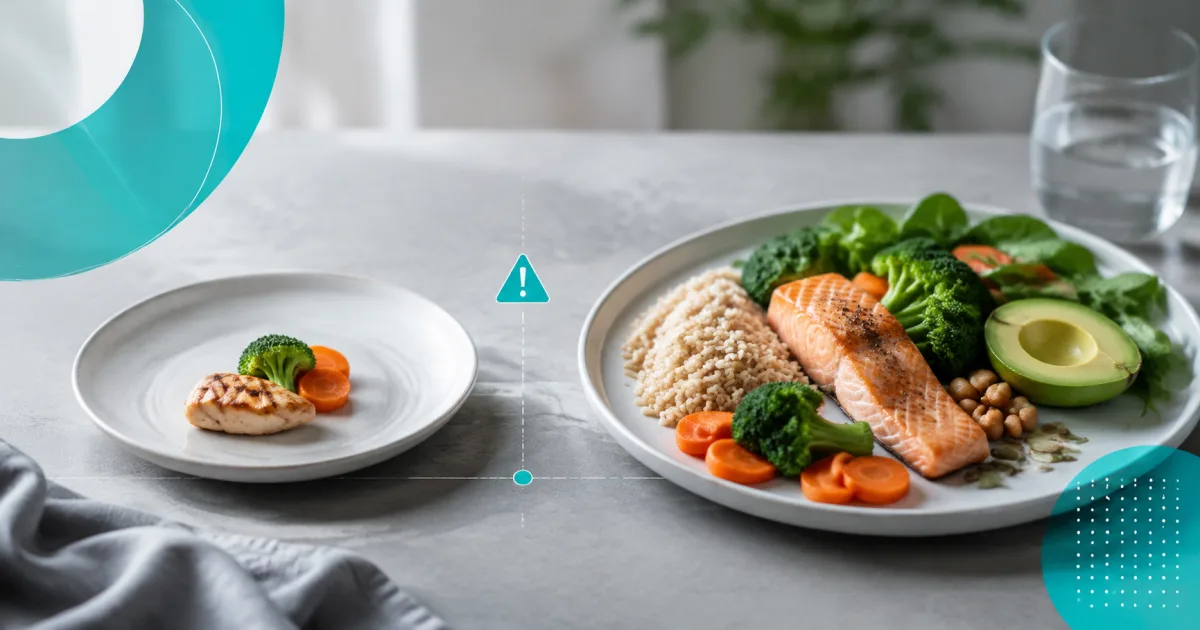
For most adults, 1,200 calories a day is too low. It sits at or below the energy many bodies burn at complete rest, and it leaves little room for the calories spent walking, working, and moving through a normal day. That doesn't make it dangerous for everyone in every situation, but as a default weight-loss target it is far more aggressive than most people realize, and the downsides tend to outweigh the faster scale movement.
Where the 1,200 number comes from
The 1,200-calorie figure is a decades-old convention rather than a personalized prescription. It circulated for years as a rough "lowest safe intake" for women in popular diet books and magazines, and many food-tracking apps still use it as a floor they won't let you set lower. The problem is that it was never meant to describe a specific person. Your energy needs depend on your sex, body size, muscle mass, age, and how much you move, so a single number can't fit a 5-foot sedentary retiree and a tall, active 30-year-old at the same time.
To see why it undershoots, it helps to separate two ideas. Your basal metabolic rate (BMR) is what you burn just to stay alive at rest. Your total daily energy expenditure (TDEE) is your BMR plus the calories you spend digesting food and being active. For a large share of adults, BMR alone lands well above 1,200, which means 1,200 total often creates a deficit far steeper than intended.
Who it might (rarely) suit versus who it's too low for
There are narrow cases where an intake near 1,200 is appropriate, but they are the exception. A smaller, older, sedentary adult with a genuinely low TDEE, working alongside a doctor or registered dietitian, may find that a target in this range still leaves a sensible deficit. Structured, medically supervised programs also use low-calorie phases deliberately and with monitoring.
For most people, though, 1,200 is too low. If you are tall, muscular, active, still growing, pregnant or breastfeeding, or an athlete, this target can undercut your needs badly. The clearest warning signs that a target is too aggressive include:
- Persistent, distracting hunger that dominates your day
- Fatigue, dizziness, or feeling cold much of the time
- Poor sleep, irritability, or trouble concentrating
- Hair thinning, or menstrual cycles becoming irregular
- Workouts collapsing in quality and strength dropping off
The risks of an over-aggressive deficit
The trouble with cutting too hard isn't just discomfort; it's that it quietly works against the goal. Four issues show up again and again.
Muscle loss. When the deficit is steep and protein or resistance training is lacking, a meaningful share of the weight lost can come from lean tissue rather than fat. Since muscle is metabolically active, losing it lowers the calories you burn and can leave you looking "soft" at a lighter weight.
Adherence. Very low intakes are hard to sustain. Extreme restriction is a strong predictor of the binge-restrict cycle, and a diet you abandon in three weeks loses to a moderate one you keep for six months.
Metabolic adaptation. As you lose weight, your body burns somewhat less than size alone predicts, partly through reduced spontaneous movement and hormonal shifts. Aggressive dieting can exaggerate this, which is why progress often stalls faster on crash plans.
Micronutrients. It is genuinely hard to fit adequate iron, calcium, B12, and other nutrients into 1,200 calories, especially if food choices aren't carefully planned. Chronic shortfalls carry real health costs that a slightly higher, better-composed intake avoids.
How to set a smarter deficit from your TDEE
Instead of anchoring to a fixed number, work backward from your own expenditure. First, estimate your TDEE with an equation like Mifflin-St Jeor plus an activity multiplier, or use a reliable calculator. Then take a modest cut rather than a drastic one.
- 1Estimate your TDEE (BMR times an activity factor).
- 2Subtract roughly 15-25% to set your target, not more.
- 3Prioritize protein (around 1.6-2.2 g per kg of body weight) to protect muscle.
- 4Add resistance training two to four times a week for the same reason.
- 5Track for two to three weeks, then adjust based on real results, not the scale on a single day.
When to see a professional
Speak with a doctor or registered dietitian before dropping to very low intakes, especially if you take medication, have a chronic condition, are pregnant or breastfeeding, have a history of disordered eating, or simply feel unwell while dieting. Genuinely very-low-calorie diets (below about 800 calories) are a clinical intervention and should only happen under supervision, not as a solo project.
The reassuring part is that you rarely need to go that low. A modest, personalized deficit built on your own numbers, protected with protein and training, usually produces steadier fat loss you can actually live with.
Frequently asked questions
Further reading on Trainera
In-depth guides from Trainera, the coaching app that sponsors this site.